Science, Complexity, and Entrepreneurial Foresight

Jacek Marczyk was born in Lodz, Poland, in 1959. In 1968 his family transferred to London, where his parents formed part of the diplomatic corps of the Polish Embassy. He lived in Belgravia and attended St. Joseph’s Primary School and St. Thomas Moore’s Secondary School in Chelsea.

After spending the period 1974-77 in Poland, the family left for Italy, where Jacek’s parents worked at the Polish Consulate in Milan. He concluded MS studies in Aeronautical Engineering at the Milan Polytechnic in 1983.

In 1986 he earned a second MS in Aerospace Engineering from the Polytechnic of Turin.

In 1991 he became an Italian citizen. That same year he moved to Madrid.

In 1998 he earned his PhD in Civil Engineering from the Universidad Politecnica de Catalunya in Barcelona.

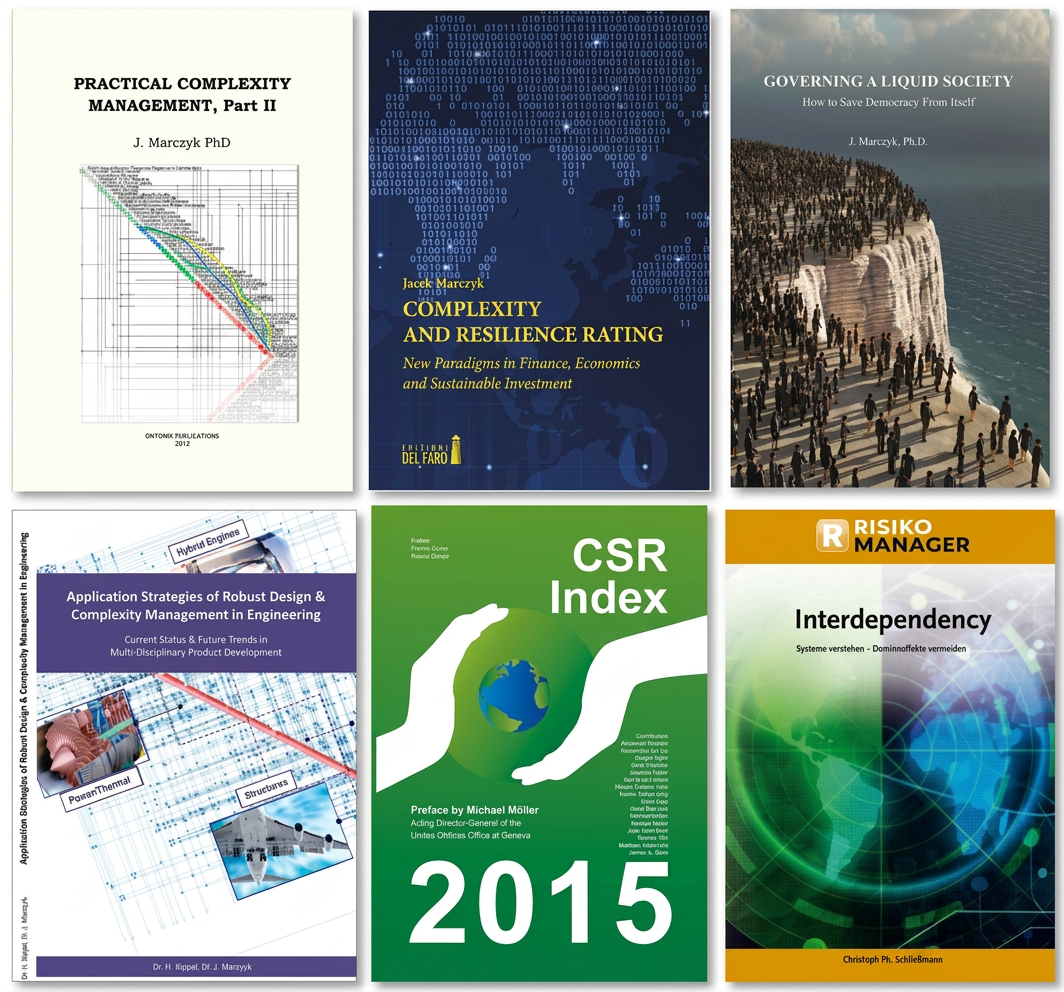
Dr. Marczyk has lived on four continents and worked in aerospace, automotive, oil & gas, computer hardware & software industries, in management and executive positions. He has published books in engineering, numerical simulation, optimization, complexity management, finance, economics and sociology. He is fluent in five languages.

In the mid 90s he developed the theory of eigenvalue orbits, a generalization of the concept of eigenvalue to nonlinear systems. This earned him his doctoral degree.

In 2000-2005 he developed the Quantitative Complexity Theory including the first comprehensive measure of complexity which combines structure and entropy. The metric establishes a link between physics and information theory as well as a candidate for the Fourth Law of Thermodynamics.

He founded Ontonix in 2005 in Italy and launched the first commercial system for MEASURING and managing complexity, OntoNet™.

Over the years, Ontonix has become an independent Think Tank, a center of independent research, beyond just a deep-tech company.

He has published diverse articles in Cardiology and Pharma Journals. He is currently researching the use of QCM in conjunction with Molecular Dynamics in order to determine physio-chemical properties of molecules.

Over the last decade he focused on the development of Quantitative Complexity Management (QCM) solutions for applications in Defence, Manufacturing, Medicine, Risk Rating, and Finance. The technology powers Artificial Intuition, and reaches beyond Machine Learning. The essence of Artificial Intuition is that it does not require numerous, often expensive examples for training. In many contexts such examples (anomalies) are very scarce, making ML impractical. Play audio below to find out about real time anomaly detection.

A Renaissance man, he is a fervent believer in radical, disruptive research, that has characterized his work throughout his career. His conviction is that R&D is the most effective form of protection of Intellectual Property from emulation, copying, reverse engineering and theft.

Since 2018 he is performing research focusing on the development of next generation Quantitative Complexity Theory, the QCT2. He is currently focusing on code development.

During his career he has worked for companies such as Tecnomare (ENI Group), EADS-CASA Space Division (Airbus), Engineering Systems International, Centric Engineering Systems, Silicon Graphics, EASi, MSC Software or at the R&D Center of BMW AG in Munich.

During the years spent in the Aerospace Industry, he worked on such space programs as Artemis, Rosetta, Cassini, Polar Platform, Hispasat, Ariane 5 and the James Webb Space Telescope.

While at BMW, during the late 1990s, he pioneered industrial applications of Artificial Intelligence and Machine Learning based on Monte Carlo Simulations software which he had written.

In early 2026 he co-founded Toronto-based BioDynLab, a company focusing on physics-based methods for acceleration of drug discovery. Adopting Dynamic Complexity Metrics, BioDynLab maps the motion of single atoms onto biological function of small molecules and proteins.

Education

1978-1983

Politecnico di Milano, Milan, Italy

MS in Aeronautical Engineering

Thesis in spacecraft attitude and orbit control system design

1984-1986

Politecnico di Torino, Turin, Italy

MS in Aerospace Engineering

Thesis in spacecraft attitude and orbit control system design

1996-1998

Universidad Politecnica de Catalunya, Barcelona, Spain

PhD in Civil Engineering

Thesis in nonlinear mechanics – theory of eigenvalue orbits

Intellectual Property
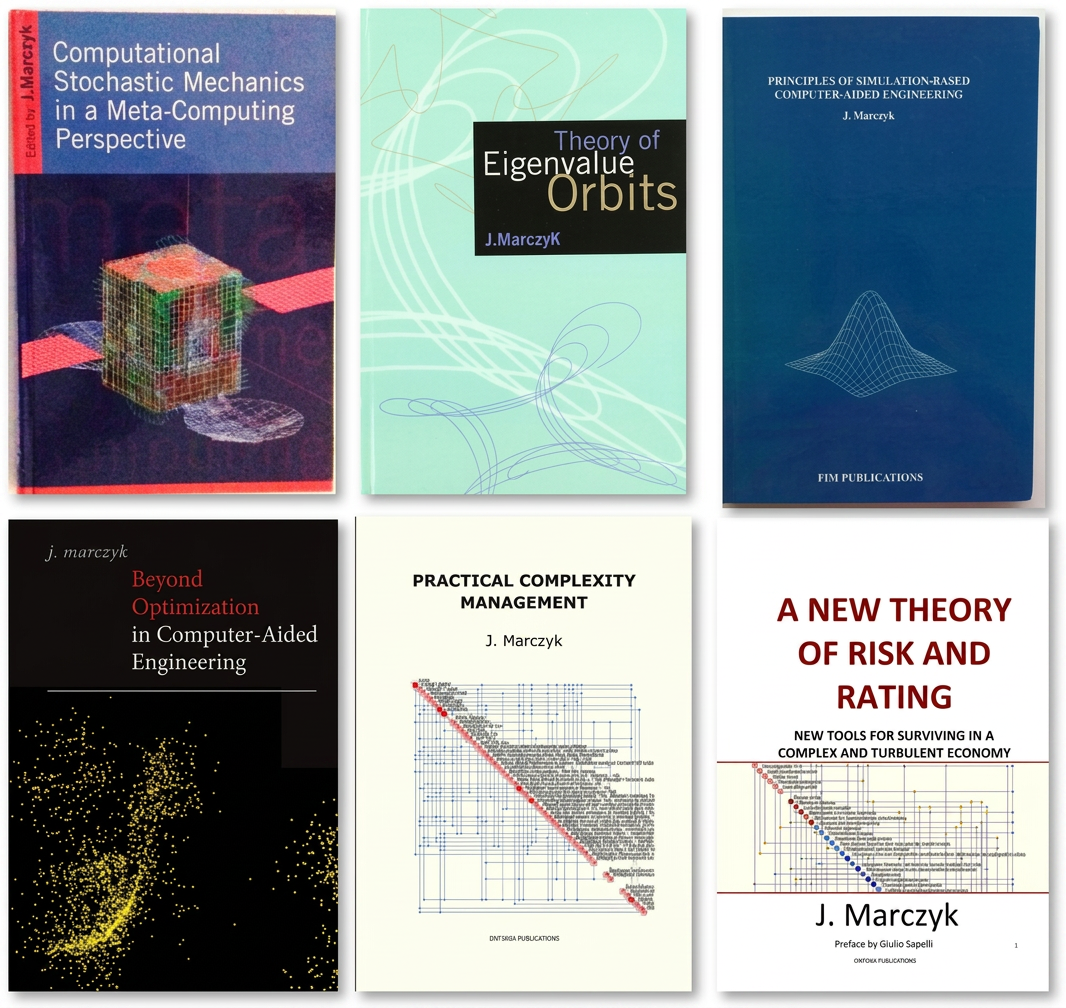
Dr. Marczyk has authored and co-authored various books and owns the following Intellectual Property:

SDI Algorithm: SDI (Stochastic Design Improvement) is a method for finding solutions to very large-scale design problems, that would be impossible to solve using classical optimization techniques. The method is a mix of genetic techniques and Monte Carlo simulation and allows one to identify multiple solutions via an inverse approach: the user specifies what performance he seeks, SDI provides which values of the design variables deliver that particular performance. Unlike conventional optimization, the method allows to use very realistic models instead of simplistic response surfaces. The SDI has been developed in 1998.

Eigenvalue Orbits: A novel approach to the problem of characterizing and controlling generic dynamic systems without a-priori knowledge of their structure. The approach stems from the concept of Eingenvalue Orbit, introduced by J. Marczyk in 1999, which provides a new means of viewing the general transient and stability properties of dynamic systems. Eigenvalue Orbits are a generalization of the concept of eigenvalue. The theory of Eigenvalue Orbits has been published in the Journal of Guidance, Control and Dynamics, a peer-reviewed publication of the American Institute of Aeronautics and Astronautics.

Generalized correlation: A novel approach to correlation which takes into account nonlinear aspects of data. The method treats data as images, emulating an expert “looking at it”. Data is analyzed by emulating the brain without the need to build math models. The method has its roots in quantum physics, nonlinear mechanics and biology.

Complexity metric: The first complexity metric for generic systems and the algorithm to compute it has been introduced by Dr. J. Marczyk in 2005. A part of the algorithm has been patented in the USA in 2009. Complexity is defined as a function of the structure of information flow within a system and entropy, which measures disorder as well as information content. Formally, complexity is defined as C = f(S; E), where S reflects structure and E is entropy (‘disorder’). Based on this formulation, complexity measures the total amount of structured information in a system. The metric is bounded – the upper bound is known as critical complexity. Marczyk’s metric is the first one which combines explicitly structure and entropy and shows that complexity is not just a number; it is an intrinsic property of all dynamical systems and its importance is comparable to that of energy. The formulation is a candidate Fourth Law of Thermodynamics and established the foundations of Artificial Intuition, an advanced form of Artificial Intelligence that does not require learning.

Artificial Intuition: The fourth generation of AI is ‘artificial intuition,’ which enables computers to identify threats and opportunities without being told what to look for, just as human intuition allows us to make decisions without specifically being instructed on how to do so. Artificial Intuition reaches beyond the conventional Machine Learning (ML) approach. The fact is that often there are not enough anomalies to learn from. Such anomalies can be hugely expensive and nobody – manufacturers or users – can provide a sufficient number of cases from which to learn. Besides, the number of possible anomalies is immense and it is impossible to define and learn to recognize them.